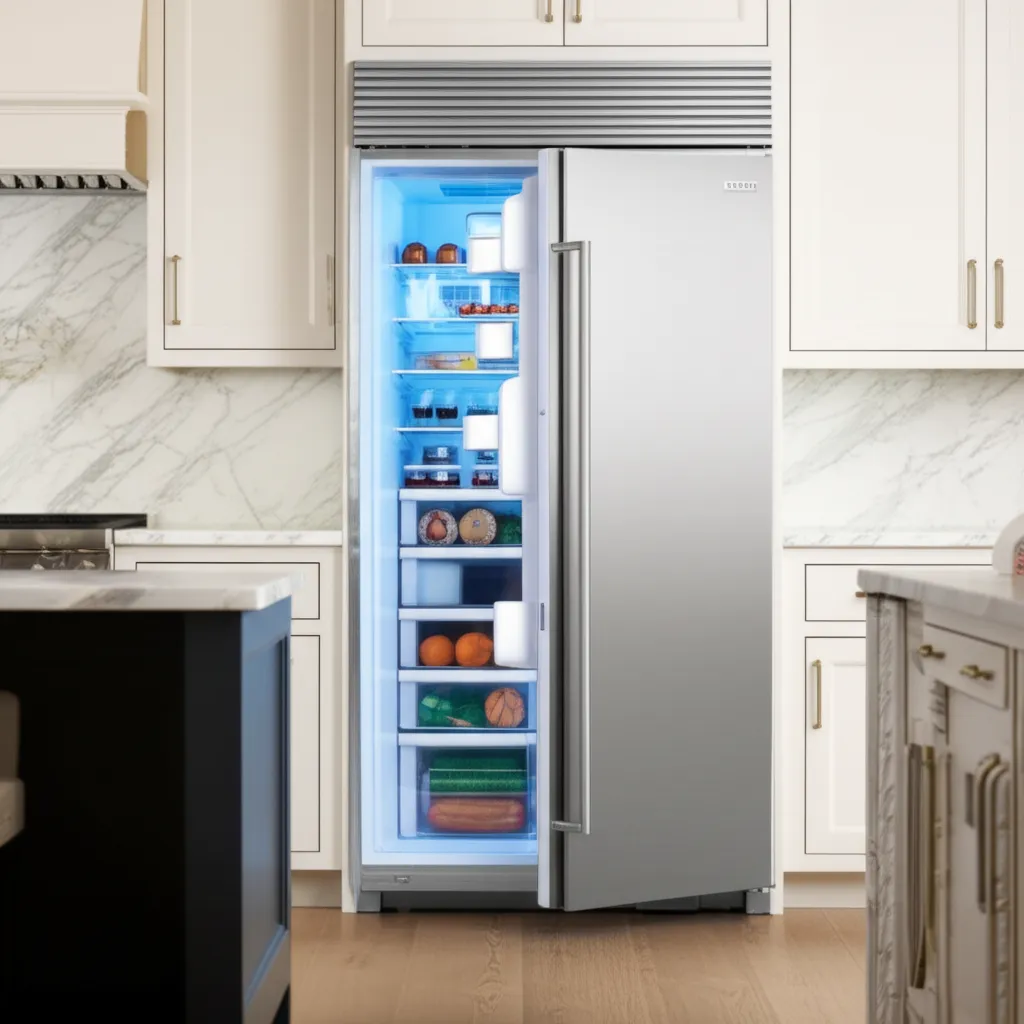
Ice Maker Repair
Sub-Zero Ice Maker Output Dropping in Brookline: Water, Fill or Freeze?
Falling ice output comes down to one of three stages: how much water reaches the mould, how long the cube has to freeze, and whether harvest releases it cleanly. The cubes already sitting in your Brookline bin narrow it down before anyone opens a panel.
Output rarely stops all at once. It fades. The bin that used to be full every morning holds a shallow layer instead, somebody starts refilling a tray, and by the time the household treats it as a fault nobody can say which month it began.
There is one date worth finding before you suspect a part: when the water filter last came out. A cartridge is a consumable with a working life, and when that life quietly runs out it does not announce itself by making the water taste wrong. It just passes less water per second than the fill cycle was built around. From there, work the chain in the order the appliance does — water arriving, water freezing, ice leaving.
The bin already contains the diagnosis
Lift a handful of cubes out and look at them before you open anything. A dished or hollow cube says the fill came up short of what the cycle asked for. A milky cube says dissolved air and minerals left solution as it froze. Cubes welded into one lump say the release side is off. Small but solid cubes are a fourth signal again.
Hollow cubes are the clearest of the four. Water freezes inward from the mould walls, so when the fill falls short the shell forms and the middle is never filled; you get a cup rather than a cube. That points upstream at flow, not at the cooling side of the machine.
Cloudiness is neither dirt nor a filtration failure. Air and minerals dissolved in the water come out of solution while the freeze progresses and end up trapped as a white core. It is a clue about what the water carries and how quickly it froze, nothing more than that.
A fused slab is different in kind. Those cubes formed properly and then bonded to one another in the bin, which is a timing and turnover question rather than evidence that the appliance has lost capacity.
Cubes that are well shaped and reasonably clear but consistently undersized are the fourth case: a fill that comes up short every single cycle rather than now and then, which usually means one fixed restriction somewhere in the supply.
Brookline kitchens are nearly always rebuilt inside a footprint that predates them — the frame houses off Walnut Street, the 1920s blocks along Beacon and Harvard. A built-in column ends up in a cabinet run with barely any side clearance, and that matters more for the next section than anything on the appliance itself.
Supply line, valve and pressure
Water reaches the mould through three things in series: a stop valve somewhere under a sink or in a basement, a run of tubing, and a fill valve on the appliance. Any one of them can throttle flow without ever leaking a drop, and throttled flow produces exactly the shallow, hollow cube people blame on the machine.
The commonest culprit is a valve nobody remembers touching. A plumber closes the stop to swap a dishwasher, reopens it a quarter turn, and the household loses a third of its ice for a year without connecting the two events. Old piercing-type saddle valves are worse: they choke at the pierce point as debris collects, and they degrade slowly enough to look like the appliance ageing.
Then there is the line itself. When a built-in has been pushed back into a tight run — and in Brookline and the South End it usually has — the tubing behind it gets folded against the wall or trapped under a levelling foot. A crushed line is invisible from the kitchen and behaves identically to a half-closed valve.
All of these reduce pressure at the inlet. Because the appliance fills for a set period rather than measuring what arrived, less pressure means less water in the mould, every cycle, forever, until somebody fixes the restriction.
A saturated filter is a flow restriction
A loaded filter restricts flow long before it changes taste, which is why taste is a poor guide to filter life. The drinking water can still be perfectly pleasant while the ice maker, which needs a certain volume inside a fixed window, quietly comes up short on every fill.
Aftermarket cartridges add a second question. The housing may accept them happily, but flow rate is not the same as fit — a cartridge built for a lower rate will fill the mould more slowly even on the day it is installed, and the symptom looks like premature saturation.
If your model accepts a bypass plug, running it briefly is informative. Output recovering strongly implicates the cartridge. It does not prove the cartridge was the only restriction, because bypassing removes the last narrow point in what may be a chain of them; a partially closed stop upstream will still be there.
On interval, the number that counts is the one printed in the use and care guide for your own series, not one that reached you second-hand. Intervals differ between models, and the honest answer is that the schedule in your documentation beats any figure printed on a webpage.
Hard water, in the parts you cannot see
Dissolved solids do two things over time. They reduce clarity in the cube, and they leave deposits on surfaces you never look at. Neither happens on a schedule, and no single hardness number describes what arrives at your particular tap.
Scale is a slow-onset fault, which is what makes it hard to spot. Nothing changes between Tuesday and Wednesday. Over a couple of years the mould surface roughens, cubes let go less cleanly, and the household adapts to a bin that is never quite full.
Whether the ice line is fed from softened or unsoftened plumbing is a separate question worth answering rather than assuming. In Jamaica Plain, where kitchens are frequently in a rear addition, the ice supply was often teed off whatever pipe happened to be closest during the build. In a Back Bay floor-through it may come off a building riser you have no access to at all. Find out which before drawing conclusions about water quality.
Freeze time, cabinet temperature and door habits
The temperature at the ice maker is not the number on the display. The display reports the compartment as a whole; the mould sits in one spot, fed by one airflow path. Interrupt that path and the freeze stage runs long even though the set point never moved.
The usual interruption is loading. Boxes stacked against a return grille, or a compartment packed to the walls, starve the mould of the cold air it depends on. Production is rated per 24 hours, and that rating assumes air can circulate.
Door habits count too, honestly. Every opening costs recovery time, and recovery time comes out of the same budget the ice maker is drawing on. A household that has started entertaining more has not broken anything; it has changed the arithmetic.
The release side of the cycle
Harvest is the second half of every cycle. Once the water in the mould is frozen the appliance warms the mould just enough to break the bond, and an ejector sweeps the cubes into the bin. Making ice and letting go of it are separate jobs, and they fail separately.
When cubes fuse into a slab, harvest is usually the reason — either it happened late, leaving cubes damp on the surface as they landed, or the bin is turning over so slowly that cubes have time to sinter together. Neither is a cooling problem.
There are two behaviours you can watch without tools. Does the ejector actually move during a cycle, or does it sit still? And does the sensing arm swing freely, or is it resting on a mound of ice and telling the control the bin is full when it is not? Either observation is worth writing down.
Stop there. Do not dismantle the module, and do not chip at a frozen mould with anything metal — the surface and the sensor sitting near it are easy to damage and awkward to source. Our Ice Maker Repair page sets out what a visit covers. A visit opens with the $95 service call, and when the fault turns out to be the fill valve, the supply line or the module itself, that work sits in the $310 to $680 range.
What is worth calling about
A wet floor, damp along the line behind the cabinet, or a compartment that has lost its hold on temperature — any one of those ends the troubleshooting and earns a call straight away. Those are not ice-quality complaints. Slow output can wait for a scheduled visit; water where it should not be cannot.
What changes when a technician arrives is measurement. The fill volume actually delivered in one cycle, the inlet pressure at the appliance rather than at the kitchen tap, and how long each stage of the cycle takes are three figures no homeowner can read, and between them they usually settle the question in a single visit.
Sub-Zero Repair Brookline covers Brookline, Back Bay and Jamaica Plain. Use the booking link or ring (617) 340-2816 — both sit at the top of this page — and have the model number and, if you can find it, the date of the last filter change ready when you do.
Still asked afterwards
Why does output drop in summer?
Three things stack up at once. Incoming water arrives warmer, so each fill takes longer to freeze. The compartment is opened more often, and every opening costs recovery time that the mould would otherwise have had. And demand goes up, so a bin that was always adequate now empties before it can refill. None of that means a part has failed — it means production and consumption have moved closer together.
Why is my ice cloudy when the tap water is clear?
Clarity in ice is about how the water froze, not how clean it is. Air and minerals dissolved in the water come out of solution as the freeze advances and get trapped in the middle, which is why the white core sits at the centre rather than on the surface. A filter removes particles and some tastes; it does not remove dissolved gas. Clear tap water and cloudy cubes are entirely consistent.
How often should the water filter be changed?
Follow the interval in the use and care guide for your own series rather than a general figure, because the recommendation varies between models and between household water conditions. What matters more is not using taste as the trigger. Flow through a cartridge falls off well before the water tastes different, so by the time anyone notices a change at the tap the ice maker has usually been under-filling for months.