Refrigerator Repair
How Long Do Fridge Freezers Last? Sub-Zero Lifespan and Age Signs
A typical freestanding fridge freezer lasts about 10 to 15 years, while a built-in Sub-Zero that is cleaned and serviced can keep running for 20 years or more. Age shows up as several faults at once, not one worn part.
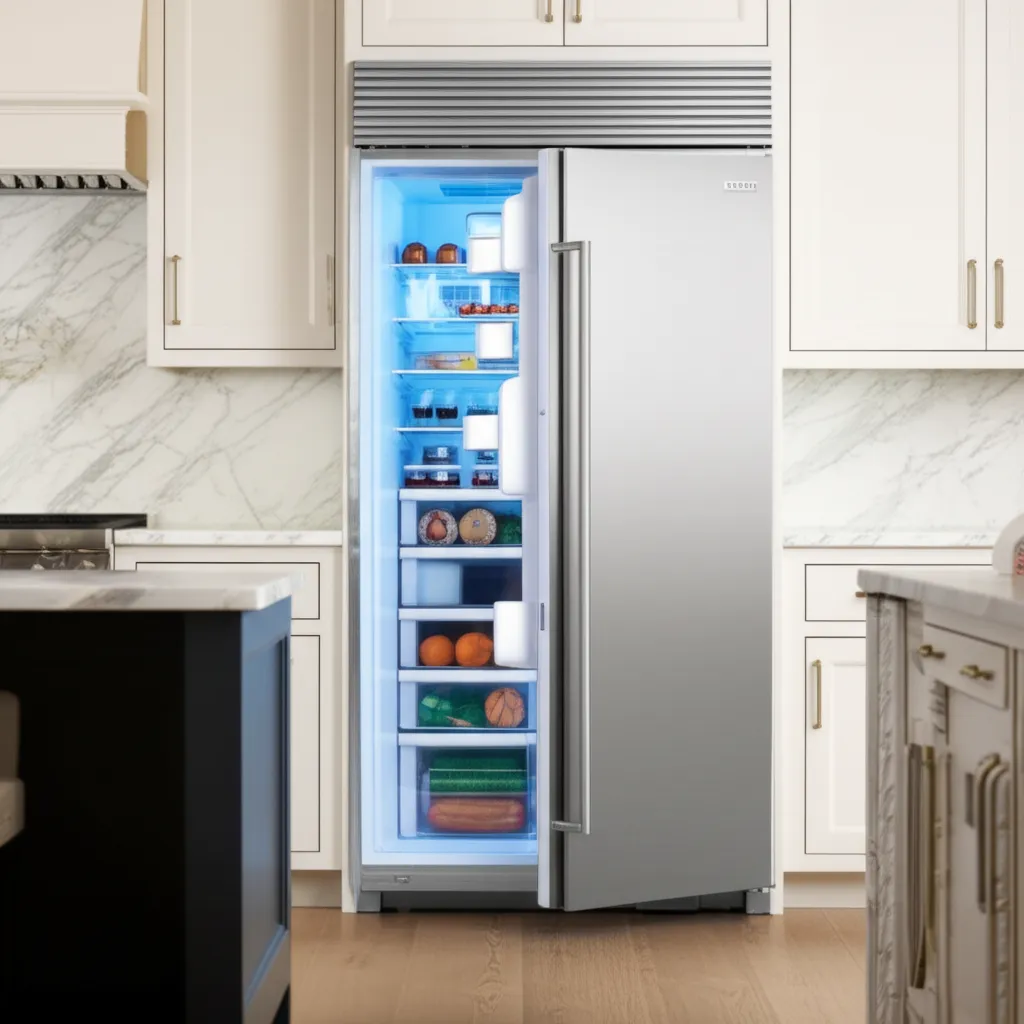
Most freestanding fridge freezers last about 10 to 15 years before a major failure makes replacement the sensible choice. A built-in Sub-Zero is a different machine: it is designed to be repaired where it stands, part by part, and many run for 20 years or more when the condenser is vacuumed every six to twelve months and the door gaskets are kept clean. So the date on the calendar matters less than one question: has a single part failed, or is the whole system wearing out at once? In Brookline kitchens, where a built-in often hides behind cabinet panels made to match the room, replacing it also means refitting that woodwork, so the answer is worth getting right.
Typical lifespans, and why built-ins outlast them
A conventional top-freezer or bottom-freezer model sits in the 10 to 15 year range. Its sealed system is rarely worth opening on a lower-priced unit, so when the compressor goes, the appliance usually goes with it. Side-by-side and French-door models with door dispensers often land at the lower end, because the extra valves, lines and small motors give out first.
Built-in refrigeration is engineered around access. On a Sub-Zero, the compressor, condenser, evaporator fans, defrost parts, control board and gaskets can each be replaced, much of it with the unit still in its opening, which is why a sealed-system repair makes sense here when it would not on a budget fridge. Sub-Zero’s records show the 600 Series was made from 1996 to 2009 and the 500 Series from 1987 to 2003. A 600 Series still cooling food today is between 17 and 30 years old, a fair picture of how long a looked-after built-in can go.
An ice maker does not shorten the refrigerator’s life, but it is usually the first component to need attention, since it fills, freezes and dumps a batch every day.
How to tell how old your unit is
Start with the serial tag, because Sub-Zero prints the manufacture date on it. For over-and-under layouts in the Classic (BI and CL), 600 Series and 500 Series families, the tag is up by the top hinge on the inner face of the refrigerator door. A side-by-side puts it on the freezer door instead, while a Classic French-door model uses the left door. Designer Column (IC, DEC) owners should open the middle drawer and look beside its guide rail, opposite the hinge. Designer Tall (IT, DET) and 700 Series units keep the tag on the cabinet wall left of the top drawer.
The model prefix narrows it further. In March 2019 Sub-Zero swapped its line names, so Built-In turned into Classic and Integrated into Designer. Legacy Classic (BI) units were built from 2008 to 2022, when the Classic (CL) series took over, and Designer Tall and Column (IT, IC) models ran from 2014 to 2022 before DET and DEC replaced them. A BI or IT prefix means some years of service behind it; a CL, DET or DEC is recent and far from worn out.
What wears out, and what a repair typically costs
Most trouble on a fridge freezer of any age traces back to a handful of parts. These are typical Greater Boston ranges, with the firm price given only after diagnosis:
- Door gasket or seal replacement: $270–$740
- Evaporator or condenser fan motor: $290–$600
- Defrost heater, thermostat or sensor: $300–$670
- Ice maker, water valve or supply line: $310–$680
- Electronic control board: $520–$880
- Compressor or sealed-system repair: $1,020–$2,230
Each is a single-part fault. A worn gasket lets in damp air, which shows up as frost and a compressor that rarely rests. A failed fan leaves one section warm while the other stays cold. A defrost fault packs the evaporator with ice until air stops moving. None of them means the refrigerator is finished. Getting an answer starts with the $95 service call, which buys the diagnosis itself; say yes to the fix and the call fee is put toward its total. Our refrigerator repair page explains the visit.
Habits that add years
The condenser is where most lifespan is won or lost. Sub-Zero’s interval is six to twelve months between cleanings, shortened if a dog or cat sheds nearby. Classic (CL) owners lift the top grille to reach it; Designer (DET, DEC) owners remove two screws and take off the kickplate. Power the unit down from its control panel first, wear gloves, and run a soft-brush vacuum attachment along the fins rather than across them so the aluminum stays straight. Sub-Zero says chemical cleaners are unnecessary and not recommended. Between cleanings, keep the front grille free of dust and lint so the condenser can shed heat and the compressor is not left running hot for hours.
Gaskets come next. For everyday grime, wipe them with a soft cloth wet with water and a drop of mild detergent. Stubborn stains respond to baking soda stirred into a paste, and mildew or mold calls for a 1:10 mix of bleach and water. Sub-Zero rules out vinegar and rubbing alcohol for this job, so leave both under the sink. A supple gasket seals, and a good seal lets the compressor cycle off.
If you defrost a freezer by hand, let the ice melt on its own or set a pan of warm water inside. USDA food-safety guidance warns against hair dryers or other electric heaters and against chipping frost with an ice pick or knife, since either can damage the liner. Frost that rebuilds within days points to a gasket or defrost fault, which a freezer repair visit can track down.
Signs that age, not one part, is the problem
One failure on an old unit is just a repair. Several at once tell a different story: the compressor runs nearly nonstop while both compartments drift warm; unrelated parts fail one after another, a fan in spring and a control board by winter; the cabinet sweats or feels hot along the sides, the liner cracks, or doors stop closing squarely as hinges wear; the electric bill climbs for no obvious reason.
On a freestanding model past ten years, two or more of those together usually mean a new one is the better buy. On a built-in, they call for a full diagnosis first, because a sealed-system repair can reset the clock on an otherwise sound cabinet. Sound is an early clue too, and our page on a refrigerator that has started making a noise separates ordinary hums and clicks from the worrying ones.
Repair or replace: put the numbers side by side
For a built-in, the arithmetic usually favors repair. Even the largest job above, a compressor or sealed-system repair at $1,020–$2,230, is a fraction of a comparable new built-in refrigerator at $8,190–$19,230 for the appliance alone, before panels and installation. A seven-year-old Sub-Zero with a failed fan or defrost sensor is nowhere near the point where replacement pays.
Replacement starts to make sense when several systems fail together, when the cabinet itself is damaged, or when parts for an older model get scarce. Sub-Zero lists most 700 Series models as out of production, which does not make them unrepairable, but ask about parts for your exact model before agreeing to a large job. For a freestanding fridge freezer, a common rule of thumb is to replace it once a repair would cost more than half the price of a new one.
Sub-Zero Repair Brookline is an independent repair service that fits factory-approved parts on refrigerators, freezers, ice makers and wine storage in Brookline, Back Bay, the South End and Jamaica Plain. Call (617) 340-2816 with the serial tag details in hand; knowing the unit’s age makes the repair-or-replace conversation much shorter.
Still asked afterwards
Is it worth repairing a 7 year old fridge freezer?
Usually yes, if only one part has failed. At seven years a built-in unit is not even halfway through a normal service life, and a single-part repair such as a fan motor or defrost sensor costs a small share of a new built-in. On a freestanding model, compare the quote with the price of a new one and think about how many other parts are nearing the end.
How do you know if your fridge freezer is dying?
The clearest sign is several faults arriving together rather than one. A compressor that runs almost nonstop, both compartments drifting warm, frost returning soon after a defrost, a cabinet that sweats on the outside and repairs to different parts within the same year all point to a system wearing out as a whole.
How long does food last in a freezer without power?
A full freezer holds a safe temperature for about 48 hours and a half-full one for about 24, provided the door stays shut. The refrigerator section keeps food safe for only about 4 hours. Food that still carries ice crystals when the power comes back can be refrozen, and so can anything a thermometer puts at 40 °F or under.
Do fridge freezers with ice makers wear out sooner?
The cabinet and sealed system last just as long, but the ice maker is usually the first part to need service. Its fill valve, supply line and motor work every day and are exposed to whatever is in the water. Work on the ice maker, its water valve or the supply line usually runs $310–$680, confirmed once the fault is diagnosed.
Which kind of refrigerator lasts the longest?
Built-in refrigeration designed to be serviced in place tends to outlast freestanding models. Sub-Zero built-in, column and PRO units are made so the compressor, fans, controls and seals can each be replaced, which lets a well-kept unit run for decades. A freestanding model is cheaper to replace than to rebuild, so one major failure often ends its life.