Ice
Ice maker repair: fill, freeze, harvest
An ice maker only does three things, and a fault almost always belongs to exactly one of them — so the fastest diagnosis is to work out which stage the machine is failing at before touching a single component.
Find the stage
Which of the three has stopped
Nothing at all, and a dry mould: the machine never filled. That is the inlet valve, the pressure at the connection, a filter that has gone past its life, or a supply line with a kink or a plug of ice in it after a shut-off. Small, cheap and common.
Cubes that are hollow, undersized or cloudy: it filled, but not properly, or it froze before the fill completed. Low pressure and a partly blocked line both produce this, and on a clear-ice machine so does a freeze plate that is no longer flooding evenly.
A full mould that never releases: the harvest stage. The heater under the mould, the motor and gear train in the module, or the arm or optics that are supposed to notice the bin is empty and ask for another cycle.
The bin tells you things
One block of ice, or a puddle underneath
Cubes fused into a solid mass usually means they sat long enough to sublime and re-bond, which points at a bin sensor that has stopped calling for ice rather than at the maker itself. Water down the freezer wall below the module is the opposite problem: the fill is overshooting, or the valve is weeping after it closes, and the excess is running out of the mould.
On undercounter clear-ice machines there is a fourth suspect the in-freezer units do not have — the drain. Those machines shed water continuously, and a drain pump or a gravity drain that has silted up will back water into the bin and turn perfectly good ice into slush.
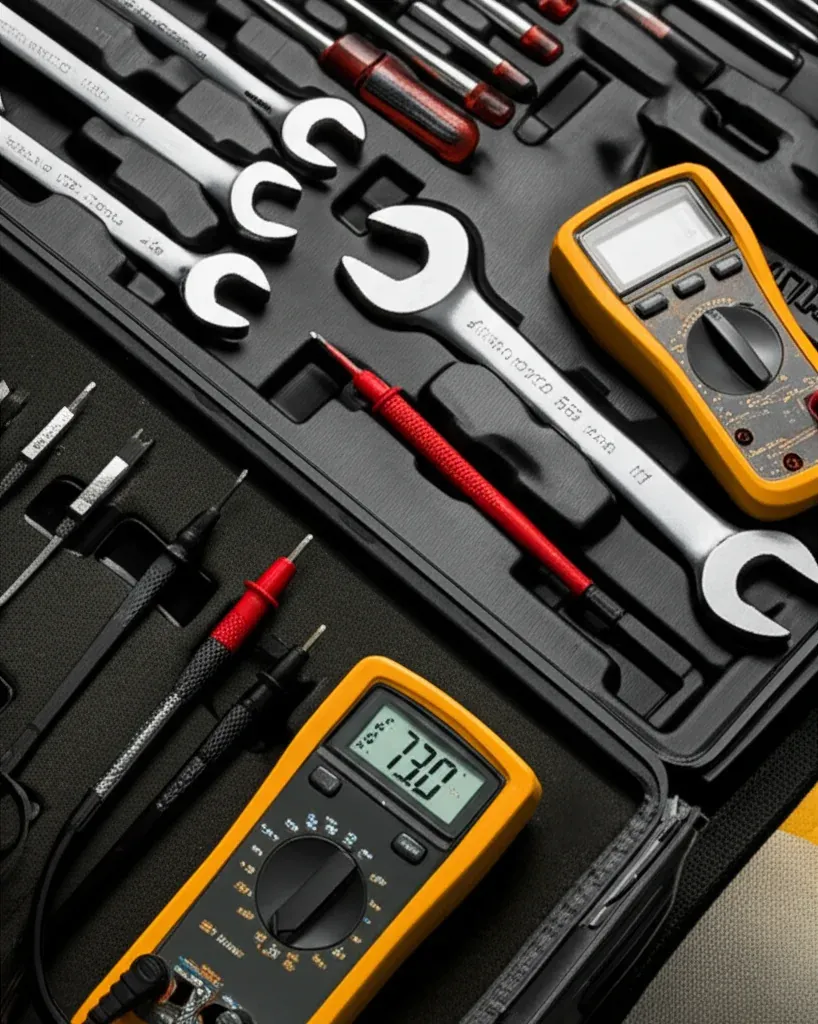
Tested on the visit:
- Inlet valve operation and the actual water pressure at the connection
- A full cycle timed end to end, through fill, freeze and harvest
- Bin sensor or shut-off arm behaviour, with the bin both full and empty
- Filter age and the condition of the line behind the unit
- On clear-ice machines, the drain path and the pump that serves it
What it costs
Ranges, then a quote
What a repair comes to depends on which component failed, whether the part rides in the van or has to be ordered for that platform, and how much of the cabinet has to come apart to reach it. These are the ranges this work falls into; the figure for your unit is quoted after the diagnosis and before anything is opened.
- Door gasket or seal replacement $270–$740
- Evaporator or condenser fan motor $290–$600
- Defrost heater, thermostat or sensor $300–$670
- Ice maker, water valve or supply line $310–$680
- Electronic control board $520–$880
- Compressor or sealed-system repair $1,020–$2,230
Flat $95 service call covering the visit and full diagnosis, credited against the repair once you approve it.
Reviews
On ice makers
5out of 5from 1,456 reviews
5 out of 5
Bin overflowing and the drain backing up. He cleared a blocked line and changed a pump that was plainly struggling. Told me what he was doing at each step, which I liked.
Charlotte Y.Back Bay
5 out of 5
Cubes were fusing into one lump in the bin. He found the harvest heater cycling far too long and the bin thermostat out of tolerance. Both sorted in one visit and the ice has stayed loose since.
Marguerite C.South End
5 out of 5
Concierge building on Commonwealth Avenue, so he rang ahead to be signed in and was upstairs on time. The ice maker had stopped filling because a saddle valve tucked behind the cabinet had corroded shut. He replaced it and the bin filled straight off.
Emeka U.Back Bay
Book it
Tell us what it is doing and we will tell you what it costs.
A flat $95 service call covers the visit and the diagnosis, and comes off the bill when you approve the repair. The line is answered 24/7; visits run 8:00 am – 8:00 pm, seven days.
- One number, quoted once
- Parts and labour arrive as a single figure before anything is opened up.
- Diagnosis you can see
- Temperatures, defrost behaviour and airflow are read in front of you.
- Independent
- An independent service business working on Sub-Zero refrigeration, with no manufacturer affiliation of any kind.